I read similarly on another long defunct blog that one can wait endlessly for the inspiration to return to writing, when in actuality writing is the only thing that can inspire me to write. Maybe this will fall through by morning: the void will return, the instigation unsubstantiated. Do I post one brooding entry after another, a sort of bloodletting for a new beginning? Much of what has transpired in these unspoken years will remain unresolved. No amount of typing will yield a satisfactory catharsis. Besides, catharsis really isn't my preoccupation: I have never been less fettered by past follies or faults than presently. And though still very much adrift, never has it been so much of my own volition. I approach the coming juncture willfully yet tentative, if not completely unprepared, having forsaken much of what I hold dear. By the end of the month I'll be homeless again, having procrastinated the necessary bureaucratic steps to know what options remain. Random entries will follow as my intentions remain inchoate.
Wednesday, December 5, 2012

Sunday, November 20, 2011
a psychology of power
"Everywhere is invasion, conquest, and domination, involving for the victors the necessity to keep and exercise power, and for the others the necessity to strive for power, in order to escape suffering and exploitation. This too is entirely functional. The conqueror is originally a pirate; he and his band do not share in the commonwealth, they have interests apart from the community preyed on. Subsequently, however, piracy becomes government, the process of getting people to perform by extrinsic motivations, of penalty and blackmail, and later bribery and training. But it is only the semblance of a commonwealth, for activity is directed. Necessarily, such directed and extrinsically motivated performance is not so strong, efficient, spontaneous, inventive, well structured, or lovely as the normal functioning of a free community of interests. Very soon society becomes lifeless. The means of community action, initiative, decision, have been preempted by the powerful. But the slaveholder, exploiters, and governors share in that same society and are themselves vitiated. Yet they never learn to get down off the people's back and relinquish their power. So some are holding on to an increasingly empty power; others are striving to achieve it; and most are sunk in resignation. Inevitably, as people become stupider and more careless, administration increases in size and power; and conversely. By and large, the cultures that we study in the melancholy pages of history are pathetic mixtures, with the ingredients often still discernible: there is a certain amount of normal function surviving or reviving - bread is baked, arts and science are pursued by a few, etc.; mostly we see the abortions of lively social functioning saddled, exploited, prevented, perverted, drained dry, paternalized by an imposed system of power and management that preempts the means and makes decisions ab extra. And the damnable thing is that, of course, everybody believes that except in this pattern, nothing could possibly be accomplished: if there were no marriage-license and no tax, none could properly mate and no children be born and raised; if there were no tolls there would be no bridges; if there were no university charters, there would be no higher learning; if there were no usury and no Iron Law of Wages, there would be no capital; if there were no mark-up of drug prices, there would be no scientific research. Once a society has this style of thought, that every activity requires licensing, underwriting, deciding by abstract power, it becomes inevitably desirable for an ambitious man to seek power and for a vigorous nation to try to be a Great Power. The more that have the power-drive, the more it seems to be necessary to the others to compete, or submit, just in order to survive. (A more importantly they are right.) Many are ruthless and most live in fear.
"Even so, this is not the final development of the belief in 'power.' For that occurs when to get into power, to be prestigious and in a position to make decisions, is taken to be the social good itself, apart from any functions that it is thought to make possible. The pattern of dominance-and-submission has then been internalized and, by its clinch, fills up the whole of experience. If a man is not continually proving his potency, his mastery of others and of himself, he becomes prey to a panic of being defeated and victimized. Every vital function must therefore be used as a means of proving or it is felt as a symptom of weakness. Simply to enjoy, produce, learn, give or take, love or be angry (rather than cool), is to be vulnerable. This is different, and has different consequences, from the previous merely external domination and submission. A people that has life but thwarted functions will rebel when it can, against feudal dues, clogs to trade, suppression of thought and speech, taxation without representation, insulting privilege, the iron law of wages, colonialism. But our people do not rebel against poisoning, genetic deformation, and imminent total destruction." PG
Tuesday, January 25, 2011
. . .
It's gone. Yesterday I got off the bus at Sukhothai and absent-mindedly left my travel journal behind. The guest house owner was kind enough to call the bus station, the bus company, even acquired the phone number for the bus driver but to no avail. He made two trips to the bus station today as well and now I must come to a bitter acceptance. All my thoughts and notes from India, Nepal, Peru, and the beginning of Southeast Asia, gone. Only one other time have I misplaced a notebook, and it was due to the same reason: neglect. (I was carrying a small notebook in my back pocket at all times and had been doing so with dwindling inspiration for years, but I stopped after this sparsely used one went missing.) Again, I haven't been writing, sincerely at least, and the manifestation is departure.
I've lost and left behind so much. Death, distance, and disassociation. And now my traveling companion. I write here in remembrance of lost spaces for my words, seeking familiarity to console my solitude.
I've lost and left behind so much. Death, distance, and disassociation. And now my traveling companion. I write here in remembrance of lost spaces for my words, seeking familiarity to console my solitude.
Friday, October 1, 2010
Friday, August 6, 2010
Monday, July 19, 2010

Thursday, June 3, 2010
of conflict and not speaking
dear self, for future reference:
"Wear your learning, like your watch, in a private pocket, and do not pull it out and strike it merely to show you have one. If you are asked what o'clock it is, tell it, but do not proclaim it hourly and unasked, like the watchman." Lord Chesterfield
"Wear your learning, like your watch, in a private pocket, and do not pull it out and strike it merely to show you have one. If you are asked what o'clock it is, tell it, but do not proclaim it hourly and unasked, like the watchman." Lord Chesterfield
Monday, April 12, 2010
le artiste manque v. family
A few excerpts from my current reading (The Denial of Death by Ernest Becker) to hold this blog over while I confront related engagements through reticence rather than composition...
"The answer is not far to seek: the depressed person avoids the possibility of independence and more life precisely because these are what threaten him with destruction and death. He holds on to the people who have enslaved him in a network of crushing obligations, belittling interaction, precisely because these people are his shelter, his strength, his protection against the world. Like most everyone else the depressed person is a coward who will not stand alone on his own center, who cannot draw from within himself the necessary strength to face up to life. So he embeds himself in others; he is sheltered by the necessary and willingly accepts it. But now his tragedy is plain to see: his necessity has become trivial, and so his slavish, dependent, depersonalized life has lost its meaning. It is frightening to be in such a bind. One chooses slavery because it is safe and meaningful; then one loses the meaning of it, but fears to move out of it. One has literally died to life but must remain physically in this world. And thus the torture of depressive psychosis: to remain steeped in one's failure and yet to justify it, to continue to draw a sense of worthwhileness out of it."
"The answer is not far to seek: the depressed person avoids the possibility of independence and more life precisely because these are what threaten him with destruction and death. He holds on to the people who have enslaved him in a network of crushing obligations, belittling interaction, precisely because these people are his shelter, his strength, his protection against the world. Like most everyone else the depressed person is a coward who will not stand alone on his own center, who cannot draw from within himself the necessary strength to face up to life. So he embeds himself in others; he is sheltered by the necessary and willingly accepts it. But now his tragedy is plain to see: his necessity has become trivial, and so his slavish, dependent, depersonalized life has lost its meaning. It is frightening to be in such a bind. One chooses slavery because it is safe and meaningful; then one loses the meaning of it, but fears to move out of it. One has literally died to life but must remain physically in this world. And thus the torture of depressive psychosis: to remain steeped in one's failure and yet to justify it, to continue to draw a sense of worthwhileness out of it."
* * *
"Men aren't built to be gods, to take in the whole world; they are built like other creatures, to take in the piece of ground in front of their noses. Gods can take in the whole of creation because they alone can make sense of it, know what it is all about and for. But as soon as a man lifts his nose from the ground and starts sniffing at eternal problems like life and death, the meaning of a rose or a star cluster - then he is in trouble. Most men spare themselves this trouble by keeping their minds on the small problems of their lives just as their society maps these problems out for them. These are what Kierkegaard called the 'immediate' men and the 'Philistines.' They 'tranquilize themselves with the trivial' - and so they can lead normal lives."
* * *
"The neurotic's frustration as a failed artist can't be remedied by anything but an objective creative work of his own. Another way of looking at it is to say that the more totally one takes in the world as a problem, the more inferior or 'bad' one is going to feel inside oneself. He can try to work out this 'badness' by striving for perfection, and then the neurotic symptom becomes his 'creative' work; or he can try to make himself perfect by means of his partner. But it is obvious to us that the only way to work on perfection is in the form of an objective work that is fully under your control and is perfectible in some real ways. Either you eat up yourself and others around you, trying for perfection; or you objectify that imperfection in a work, on which you then unleash your creative powers. In this sense, some kind of objective creativity is the only answer man has to the problem of life. In this way he satisfies nature, which asks that he live and act objectively as a vital animal plunging into the world but he also satisfies his own distinctive human nature because he plunges in on his own symbolic terms and not as a reflex of the world as given to mere physical sense experience. He takes in the world, makes a total problem out of it, and then gives out a fashioned, human answer to that problem. This, as Goethe saw in Faust, is the highest that man can achieve."
Friday, February 12, 2010
mr. sinister and his little blue booties

Starting today I am officially unemployed (though I was on leave so I haven't actually shown up to the factory in some time now). Farewell anachronic test station! Farewell dot matrix printer! Farewell acoustic-traumatizing, industrial cooling fans! Farewell beige, padded cubicle walls! Farewell blue, bell-bottomed pantsuit! Oh wait, girl in photograph is not a likeness. Farewell soul-eating wage-slavery! Farewell!!!
So... what now?
So... what now?
[...what it feels like from the inside.]
Tuesday, February 2, 2010
then
Eight
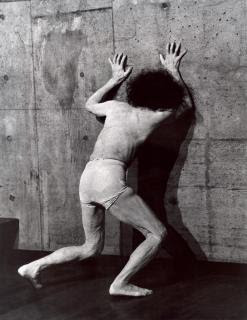
"I weep not with remorse but for the fear that I shall not be able to satisfy my passion." ('Tis A Pity)
Nine
No More Masterpieces
Ten
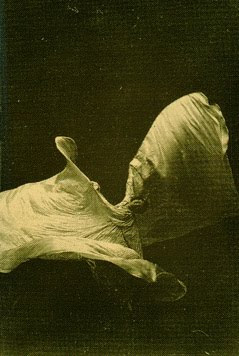
...

"I weep not with remorse but for the fear that I shall not be able to satisfy my passion." ('Tis A Pity)
Nine
No More Masterpieces
"One of the reasons for the asphyxiating atmosphere in which we live without possible escape or remedy - and in which we all share, even the most revolutionary among us - is our respect for what has been written, formulated, or painted, what has been given form, as if all expression were not at last exhausted, were not at a point where things must break apart if they are to start anew and begin fresh." Artaud
Ten

...
Subscribe to:
Comments (Atom)